
Golux Group

Ars Respirandi: A Wellness Product With a Number Behind It

Ars Respirandi: A Wellness Product With a Number Behind It

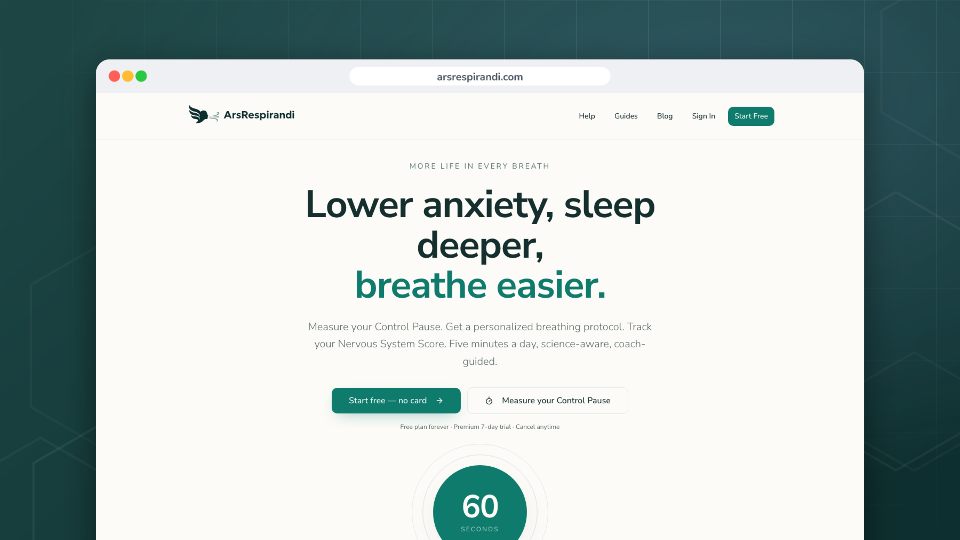
A subscription breathing platform anchored to one objective daily measurement, with the safety obligations of the category treated as product requirements rather than a disclaimer.

Open the live product
  • Application
  • Backend
  • Design
Location
Belgrade, Europe
Team
Golux Group
Project type
SaaS · Wellness product
Year
2026

Business challenge

Breathing and meditation apps are usually a timer wrapped around a content library. A user practices for three weeks, cannot tell whether anything changed, and stops, because nothing in the product measures the thing it claims to improve. The category also carries a real obligation that most apps handle with a line in the terms: breath-hold work is genuinely contraindicated for several conditions, and a product that encourages maximum holds is giving advice it is not qualified to give.

What we did

Practice is anchored to the Control Pause, a timed breath hold after a normal exhale that the user measures once a day, which gives the product one objective marker to plan against and report on. A protocol is matched to one of five stated outcomes, and a Nervous System Score tracks progress with symptom-to-measurement correlation rather than streak counts. The methods are named and attributable, Buteyko, coherent breathing, box breathing, 4-7-8 and HRV-paced sessions, which is what lets the product be specific instead of mystical. An AI coach is grounded in the user's own measurements, mood and history, with memory across sessions, so it asks what a coach would ask. Safety is built in: comfort measurements rather than maximum breath holds, and contraindications published on the page rather than buried.

What shipped

  • A free tier that works permanently, and Premium at $6.99 a month or $49 a year with a 7-day trial
  • Over fifty protocols and structured programs, with data export
  • An AI coach that reads the user's own Control Pause, mood and streak history rather than answering generically
  • Contraindications published openly, with comfort-based measurement chosen over maximum breath holds

How we built it

The brief was a wellness product in a category full of them. The first real decision was refusing to build what the category builds, which is a timer wrapped around a library of audio. That product is cheap to make and it has no way of proving anything to the person using it.

So we went looking for a measurement. The Control Pause is a timed breath hold after a normal exhale, measured once a day and used as a proxy for CO2 tolerance. It is a measure from the Buteyko method rather than something we invented, and it takes less time than opening the app usually does. Once there was one objective daily number, the whole product had a spine: something to plan against, something to report, and a reason to return that is not a streak.

Then the safety work, which happened before the feature work rather than after it. Breath hold practice is genuinely contraindicated for several conditions. We chose comfort measurements over maximum holds, wrote the contraindications out, and put them on the public page instead of in the terms. That decision costs conversions and it is not negotiable, because the alternative is a product giving advice it is not qualified to give.

Structure followed from there. Five outcome tracks so the protocol matches the goal, named methods so the content is specific rather than mystical, and a Nervous System Score that correlates symptoms against the measurement instead of counting sessions. The AI coach came last and deliberately so: it reads the person's own measurements, mood and history, because a coach that does not know your numbers is a chat window with a costume on.

AI helped throughout the build in the ordinary way, drafting, checking, accelerating the known parts. The judgment about what the product would and would not claim was made by people, in quiet, with the contraindication list open.

The method, in order

  1. Find the number the product will live on

    Before features, we looked for one existing, cheap, daily measurement. A product that cannot measure its own claim has no way to earn trust and no way to keep someone past week three.

  2. Do the safety work first

    Contraindications identified, conservative measurement chosen, both published rather than buried. In a category that touches health, this is a design constraint, not a legal footnote.

  3. Let structure follow the measurement

    Outcome tracks, protocols and scoring were all derived from the daily marker, so nothing in the product is decorative.

  4. Name the methods

    Buteyko, coherent breathing, box breathing, 4-7-8, HRV paced. Attributable methods can be looked up and argued with, which is exactly why they build more confidence than invented ones.

  5. Add AI only where it has context

    The coach ships last and reads the user's own data. Bolting a general chat window onto a wellness app adds cost and subtracts credibility.

Built with

  • React
  • TypeScript
  • Node.js
  • PostgreSQL
  • LLM APIs

For your product

What we would do on your product

If your product makes a claim about someone's health, money or children, we will ask what measures it and what happens when it is wrong, and we will ask in the first week rather than at launch. That conversation is uncomfortable and it is the one that protects you. Then we build in the order that de-risks fastest, and you see the reasoning in writing at every step.

Questions people ask

Why anchor a wellness product to a measurement?
Because without one the product cannot show a user that anything changed, and that is why people stop after three weeks. A measurement gives both the user and the product something real to work with.
Why publish contraindications so prominently?
Because the practice genuinely is contraindicated for some conditions, and a product that hides that is making a decision on the user's behalf that it has no standing to make. It costs some signups. It is still correct.
Where does AI fit in a product like this?
In the coaching layer, grounded in the user's own measurements and history, with memory across sessions. Not as a general chat window, which adds cost and subtracts credibility in a category where credibility is the product.
Do you build subscription products end to end?
Yes. Free tier, trial, billing, account state and the entitlement logic underneath it. That last part is where most subscription products quietly break, and it is worth getting right before launch rather than after.

What the work covered

  • Backend development
  • Frontend development
  • Product design
See everything we do

Your project

Want an outcome like this one?

Start with a realistic budget and timeline for your own product, or bring the problem straight to the engineer who would work on it.

The engineering notes

What we find inside AI-built apps.

The findings from the apps we audit, the fixes that worked, and what each one cost, written by the person who did the work. No roundups, no reposts.

A few emails a month. No spam, unsubscribe any time.

Golux Group

Already a client? Golux Club
is where your project lives: tickets, approvals, files, one record.

Open